Quote normalization
How to compare wedding venues by cost per guest-hour
Normalize venue proposals by attendance, usable event time and included infrastructure without letting one metric hide missing costs.
Why raw totals mislead
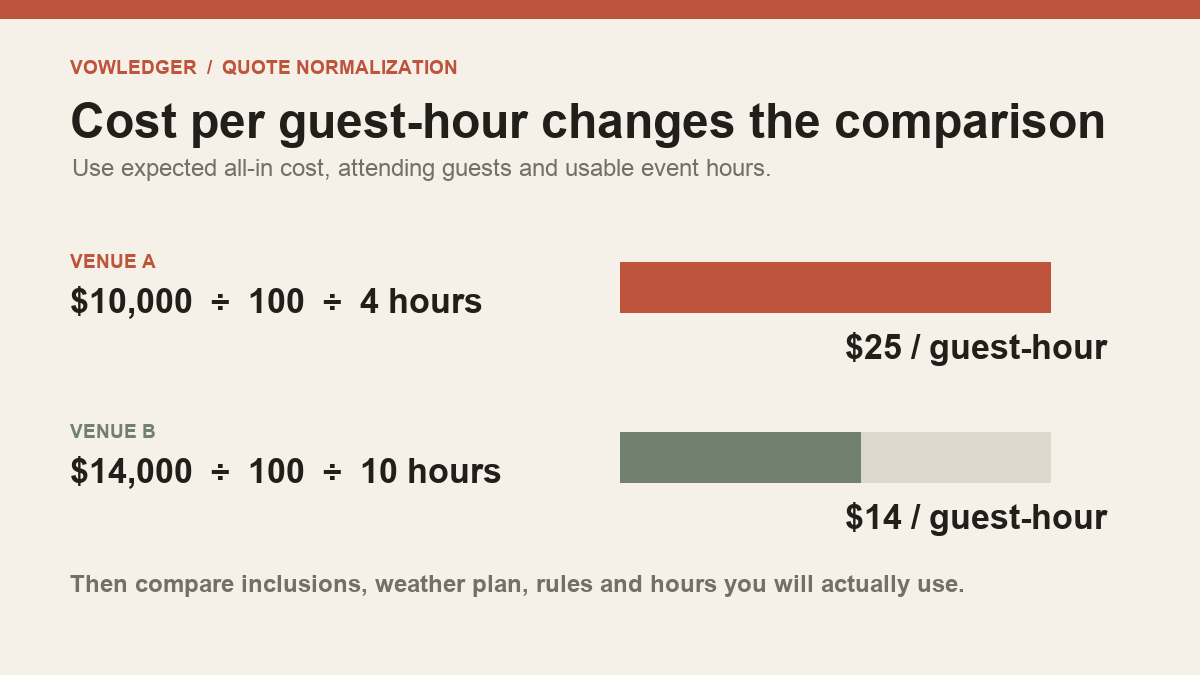
A $10,000 venue used by 100 guests for four hours represents $25 per guest-hour. A $14,000 venue used by the same group for ten hours represents $14 per guest-hour. The second proposal may provide more access and value even before comparing inclusions.
Formula
Total ÷ guests ÷ usable hours
Use expected all-in venue cost and guest-facing event hours consistently across every quote
Use an all-in numerator
Start with the expected cost required to deliver the same event: room, mandatory fees, tax, essential rentals, required staff and necessary production. Keep optional upgrades separate. If a cost is unknown, mark the metric provisional instead of using $0.
Define hours consistently
Guest-facing hours and vendor-access hours answer different questions. Guest hours measure the experience. Vendor hours reveal whether one proposal creates overtime or rush-labor risk. Track both, but do not mix them in the same denominator.
- Ceremony access
- Cocktail hour and reception time
- Getting-ready-room access
- Vendor setup and soundcheck
- Vendor teardown and rental pickup
Do not let the ratio choose the venue
Cost per guest-hour is a normalization tool, not a quality score. A venue can produce a low ratio because it includes many hours you do not need, or a high ratio because it offers an exceptional location. Use the number to identify questions, then weigh weather backup, staff, capacity, transportation and vendor freedom.
Questions about quote normalization
How do I calculate wedding venue cost per guest-hour?
Divide the expected all-in venue cost by the expected attending guests, then divide by the guest-facing event hours. Use the same definition of cost and time for every venue.
Should cost per guest-hour decide which venue wins?
No. It is a normalization tool. Weather backup, staff quality, layout, location, vendor freedom and the hours you will actually use still matter.