Catering minimums
Wedding catering minimums: food-and-beverage rules
Learn how wedding catering minimums work, what counts toward a food-and-beverage minimum, and how service charges, tax and guest count affect the final bill.
What is a wedding catering minimum?
A wedding catering minimum—also called a food-and-beverage minimum or F&B minimum—is the amount a contract requires you to spend on eligible food and drinks for a particular room, date or event window. It is a spending floor, not necessarily the price of a package.
If the menu and bar selections for your final guest count fall below the floor, the contract may still require the full minimum. The important number is therefore the larger of the eligible menu spend and the contractual minimum, followed by any service charge, tax and other required fees.
Planning formula
The greater of menu spend or minimum
Then add the mandatory service charge, applicable tax and any required costs that do not count toward the minimum.
A minimum and a per-person price are different
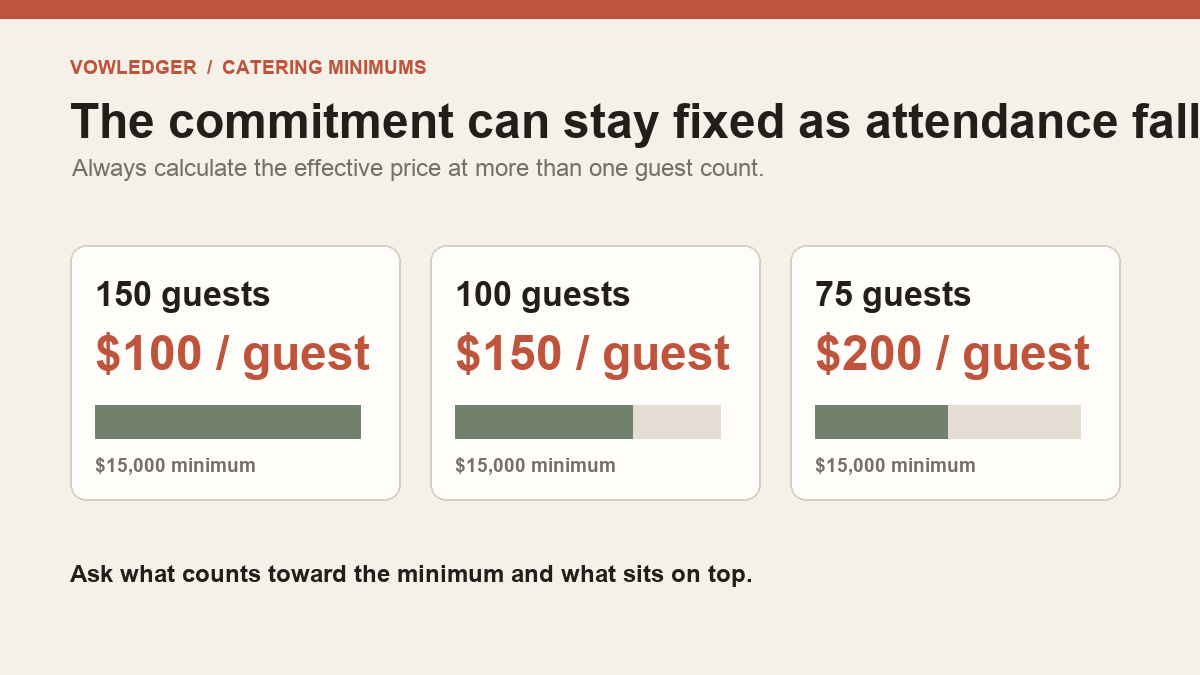
A per-person price multiplies with attendance. A catering minimum can stay fixed even when attendance falls. Always compare both figures: the menu price at your expected guest count and the minimum tied to the date or room.
Suppose a venue requires a $15,000 minimum. At 150 guests, that floor equals $100 per guest before fees. If only 100 attend, it becomes an effective $150 per guest unless the contract lets you use the shortfall on eligible upgrades such as better entrées, a hosted bar or late-night food.
Guest-count example
$15,000 either way
$100 per guest at 150 people; $150 per guest at 100 people, before service charge and tax
What usually counts toward a food-and-beverage minimum?
Only the written venue or caterer policy can answer this for your event. Food and hosted beverages often count. Room rental, service charge, sales tax, gratuity, staffing and rentals often sit outside the minimum, but policies vary. Ask for an itemized sample calculation and a written list of eligible purchases.
- Plated meals, buffets and stations
- Hosted bar packages or beverage consumption
- Cocktail-hour food and late-night snacks
- Children’s and vendor meals
- Cake, coffee service or specialty stations when the contract includes them
- Rentals, room fees and labor only when the contract explicitly says they count
Service charge and tax can sit on top of the minimum
A $15,000 catering minimum is not necessarily a $15,000 final catering bill. If a 24% mandatory service charge applies, the subtotal becomes $18,600 before tax. If 8% sales tax then applies to that combined amount, the illustrative total becomes $20,088. The contract and local tax rules determine the real calculation.
Ask whether the service charge counts as staff gratuity, whether it is taxable and which subtotal receives each percentage. Do not assume a mandatory administrative charge is distributed to servers or bartenders.
Illustrative plus-plus total
$20,088
$15,000 minimum + 24% service charge + 8% tax on the combined amount
What happens if you do not meet the catering minimum?
The contract may require the couple to pay the shortfall, upgrade eligible food or beverage selections, or meet the same total through another approved item. A lower final guest count does not automatically reduce the obligation.
Before signing, ask the venue to show a sample bill at both your expected guest count and a conservative lower count. Also confirm the final guarantee deadline, because that is often when the headcount used for billing becomes fixed.
Questions to ask before accepting a catering minimum
Get the answers in the proposal or contract. A verbal explanation is difficult to use later if the guest count, menu or room changes.
- What exact minimum applies to our date, room and event hours?
- Which food, bar and upgrade purchases count toward it?
- Do service charge, administrative fees, gratuity or sales tax count?
- What happens if our eligible spend falls short?
- Can the minimum change if we switch the day, room or guest count?
- When is the final guest guarantee due, and can it decrease afterward?
- Are vendor meals, children’s meals and nonalcoholic packages eligible?
Compare the commitment, not just the menu price
Price the venue at a realistic attendance range, include every mandatory percentage and keep the minimum visible even when the per-person calculation is lower. The useful comparison is the expected out-of-pocket total for the same date, guest count and service level.
A higher minimum can still be reasonable when it includes more event value, but it creates a larger fixed commitment. Compare that commitment with the room fee, included rentals, vendor restrictions, payment milestones and cancellation terms before signing.
Sources and policy snapshots
These links support the examples above. Each is a dated public policy, not a prediction of what another vendor will require.
- Hotel 1928 event FAQ: A public example of a food-and-beverage minimum that excludes service charge and sales tax.
- Westin Dallas Downtown wedding FAQ: A public venue policy stating that the contractual minimum must be met before tax and service charge.
Questions about catering minimums
What is a wedding catering minimum?
A wedding catering minimum, food-and-beverage minimum or F&B minimum is a contractual spending floor for eligible food and drinks. If attendance falls, the same minimum may still be due, which raises the effective cost per guest.
Do tax and service charge count toward the minimum?
Often they do not, but the contract controls. Ask for a written list of eligible purchases and whether the minimum is measured before or after service charge and tax.
What happens if we do not meet the food-and-beverage minimum?
You may still owe the shortfall or be allowed to spend it on eligible menu and bar upgrades. Ask the venue to state the shortfall policy in writing before signing.
Does a lower guest count reduce the catering minimum?
Not automatically. A minimum can remain fixed for the date or room even when fewer guests attend. Calculate both the menu spend and the contractual floor at a conservative attendance estimate.