Deposit and retainer guide
Wedding deposit amounts by vendor: what to expect
There is no standard wedding deposit. Compare real venue policies, separate retainers from refundable security deposits and map every payment deadline before signing.
How much is a normal wedding venue deposit?
There is no single normal amount. Current public venue policies use both flat booking payments and percentages of the expected total. In the examples checked for this guide, one venue requires a $900 non-refundable deposit, another requires a $1,000 non-refundable retainer plus a separate $750 refundable damage deposit, a city venue requires 50% at contract signing, and a municipal venue policy requires a 25% non-refundable payment for bookings over $1,000.
Those examples demonstrate variation; they are not a representative national average. The useful comparison is how much cash is due now, whether it is credited toward the total, what portion can be refunded or transferred, and which deadlines make more money non-refundable.
The honest short answer
Fixed amount, 25% and 50% all exist
Read the current contract instead of treating one percentage as an industry standard.
Deposit, retainer and damage deposit are different jobs
A booking payment reserves a date and is usually applied to the contract total. A document may call it a deposit, reservation fee or retainer, but the cancellation clause—not the label alone—explains whether it can be returned or moved to another date.
A security or damage deposit is different. It may be held in addition to the rental price and returned after the event if the space is left on time and without damage. Keep it in the cash-due schedule, but do not count it as part of the final cost when the written terms make it fully refundable.
- Amount due to reserve the date
- Whether the payment reduces the remaining balance
- Refundable, non-refundable or transferable status
- Separate damage, cleaning or key deposits
- The date and conditions for returning refundable money
What to compare for each wedding vendor
Venue and catering commitments often depend on an estimated event total, guest count or food-and-beverage minimum. Photographers, planners, florists, DJs and rental companies may instead use a fixed retainer or a percentage of the selected package. The proposal should state both the booking payment and the full contracted price.
Do not compare vendors by deposit alone. A smaller deposit can sit in front of a larger total, while a larger first payment may simply reduce the later balance. Rebuild every proposal as a dated payment schedule.
- Venue: site fee, food-and-beverage minimum, damage deposit and date-change policy
- Catering and bar: estimated total, guest-count adjustment, service charge and final guarantee date
- Photography or video: package total, retainer, coverage changes and cancellation schedule
- Planner, florist, DJ and rentals: retainer, design or inventory deadlines and final-balance date
Turn the contract into a cash-due timeline
List every due date from signing through the wedding, then separate payments that are refundable, conditionally refundable and non-refundable. Include the final guest-count deadline because it can convert an estimate into a binding balance.
- Today: contract total, booking payment and separate security deposit
- Each milestone: dollar amount or percentage and the subtotal it uses
- Cancellation dates: how much is kept at each point
- Rescheduling: whether money transfers and whether a new fee applies
- Final reconciliation: overtime, consumption bar, damages or other post-event charges
Questions to answer before sending money
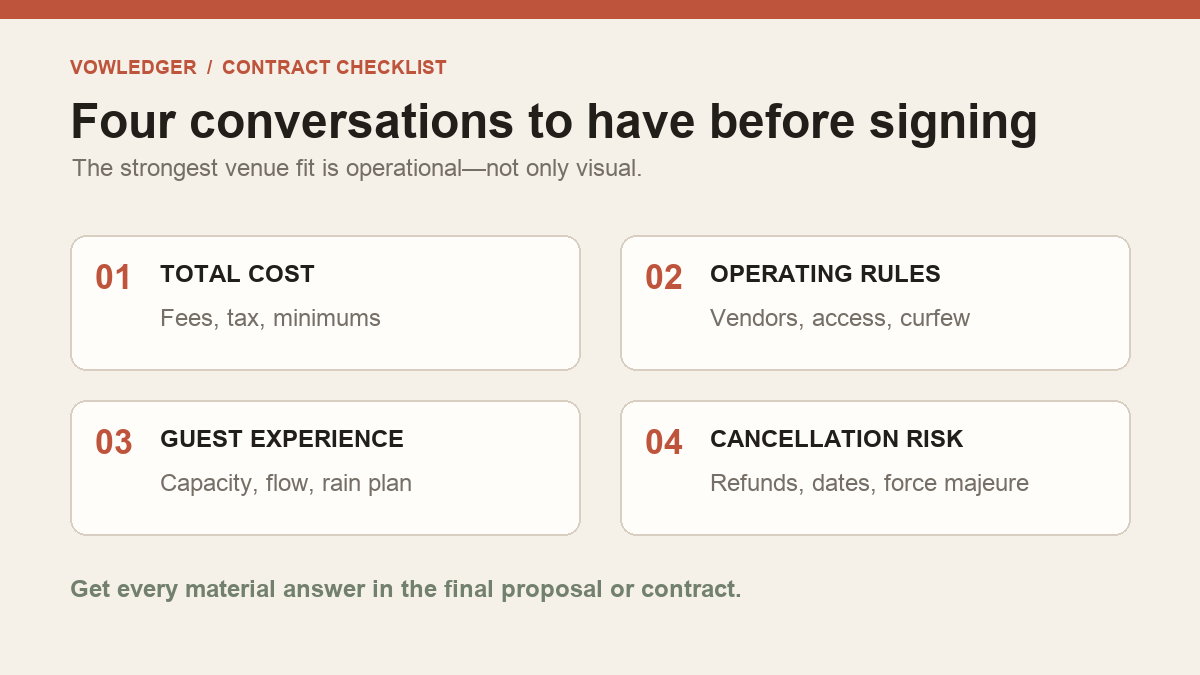
Ask the vendor to put every answer in the proposal or contract. A payment receipt without clear written terms does not explain the full commitment.
- Does this payment reserve the date, and does it count toward the full price?
- Exactly when does each payment become non-refundable?
- Can the payment transfer to a new date, package or service?
- What happens if the vendor cannot perform?
- Are credit-card fees, taxes or service charges added to a deposit payment?
- Is a refundable security deposit held separately from the venue fee?
How these examples were checked
The examples below link to public venue or government pages checked on September 16, 2026. They are evidence that contract structures differ—not a claim that the same terms apply to another vendor. Policies can change, so request the current agreement before paying.
Sources and policy snapshots
These links support the examples above. Each is a dated public policy, not a prediction of what another vendor will require.
- Round Lake Vineyards wedding FAQ: $900 non-refundable booking deposit; remaining payments due by the five-week appointment.
- SpringHaus Farm wedding FAQ: $1,000 non-refundable retainer plus a separate $750 refundable damage deposit, followed by later installments.
- Fort Wayne Promenade Park booking guidance: Signed contract and 50% deposit are required to hold a date.
- City of Calgary Ralph Klein Park wedding policy: Bookings over $1,000 require a 25% non-refundable payment under the published policy.
- Chicago Park District permit and rental guidance: A $200 refundable security deposit is listed in addition to the wedding permit rental fee.
Questions about deposit and retainer guide
How much is a typical wedding venue deposit?
There is no universal amount. Current public policies include fixed retainers as well as 25% and 50% booking payments. Compare the current contract’s full price, refund rules and payment schedule instead of relying on one industry percentage.
Does a wedding venue deposit count toward the total?
It often does, but the written agreement must say so. A separate damage or security deposit may be refundable and may not reduce the venue fee.
Is a wedding retainer refundable?
The cancellation and rescheduling clauses control. Record when the payment becomes non-refundable, whether it can transfer to another date and what happens if the vendor cannot perform.