Cancellation and refund guide
Wedding venue cancellation policies: deposits, refunds and rescheduling
Turn a wedding venue cancellation clause into a dollar-loss timeline, then compare refund deadlines, rescheduling rights and force-majeure remedies before signing.
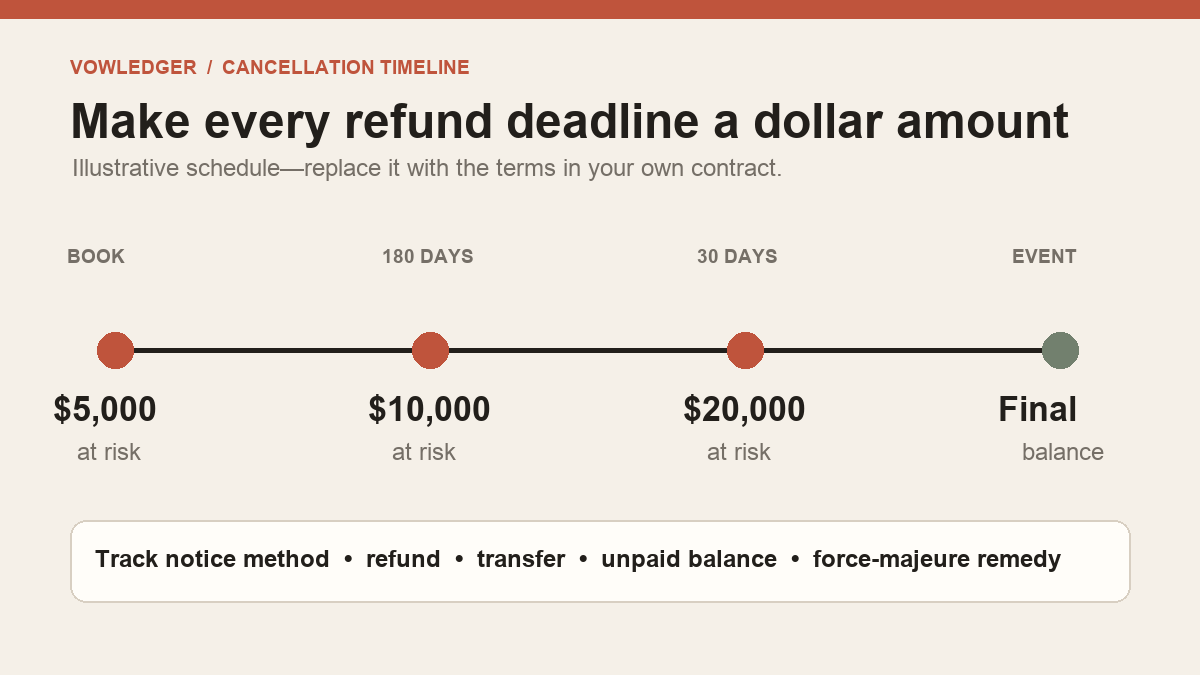
A cancellation deadline is also a dollar amount
Do not stop at “the deposit is non-refundable.” Build a timeline showing how much money is at risk after every payment and cancellation deadline. A contract may protect the first retainer, make later installments non-refundable as they are paid, or require more of the remaining balance as the event approaches.
Public policies differ sharply. Decatur House publishes a stepped refund schedule for its rental-fee deposit, while Events at Judson Mill publishes a one-year cancellation threshold and says later payments, other than the security deposit, are non-refundable. Those are examples of different structures—not a national standard.
Convert the clause into a cancellation-loss timeline
Copy each payment date into a table. For every date, record the amount paid to date, the amount refundable on that date, any cancellation fee and whether the unpaid balance can still become due. Use exact calendar dates rather than phrases such as “six months before.”
- Date the written cancellation notice must be received
- Payments kept, returned or credited at that point
- Processing or cancellation fee deducted from a refund
- Whether the security deposit is handled separately
- Whether rebooking the date changes the refund
- Deadline and required form for written notice
Illustrative contract timeline
$5,000 → $10,000 → $20,000 at risk
On a hypothetical $20,000 contract, more payments become non-refundable at 180 and 30 days; this is a calculation example, not an industry norm.
Rescheduling is not the same as cancelling
A date-change clause should explain whether existing payments transfer, how long you have to select a new date, which dates or seasons are available, and whether current pricing replaces the original rate. A credit that only works on limited dates is not the same as a cash refund.
Ask what happens if the venue has no mutually acceptable date, a replacement date costs more, or a key vendor cannot move. Confirm whether a second postponement is allowed and whether cancellation terms reset after the change.
Read the remedy inside force-majeure language
The list of disasters is less useful than the promised remedy. Look for who decides that performance is impossible, whether the first remedy is rescheduling or an alternate venue, how payments transfer, what costs may be withheld and whether either party can eventually request a refund.
Events at Judson Mill, for example, publishes language that applies payments to a rescheduled date or partner location and describes a discretionary partial refund after incurred costs when the client declines those options. Your contract may be different. If the financial consequence is unclear or important, consider having a qualified local attorney review the agreement.
Questions to resolve before paying
Ask the venue to answer material questions in the agreement or a signed amendment. This guide is a planning checklist, not legal advice; the signed contract and applicable law control.
- How much money would we lose if we cancelled on each payment date?
- Can any unpaid balance become due after cancellation?
- Do payments transfer to a new date, and for how long?
- Who chooses the replacement date and what price applies?
- What happens if the venue—not the couple—cannot perform?
- What is the remedy after a force-majeure event?
- Must notice be mailed, emailed or submitted on a particular form?
How these examples were checked
The public policies below were checked on September 23, 2026. They show why the same questions can produce different answers. They do not replace the current contract for your event, and a venue may change its public terms.
Sources and policy snapshots
These links support the examples above. Each is a dated public policy, not a prediction of what another vendor will require.
- Decatur House rates and restrictions: Publishes a stepped cancellation-refund schedule, a processing fee and separate refundable security-deposit terms.
- Decatur House event FAQ: Publishes the signing payment, remaining-balance deadline and refundable security deposit.
- Events at Judson Mill contract FAQ: Publishes cancellation, rescheduling and force-majeure explanations with specific remedies and deadlines.
Questions about cancellation and refund guide
How do I read a wedding venue cancellation policy?
Build a timeline for every payment and cancellation deadline. At each date, record how much has been paid, how much can be refunded, any cancellation fee, whether unpaid amounts become due and whether money can transfer to a new date.
Can a wedding venue deposit be transferred to a new date?
Only when the contract or a written amendment allows it. Confirm the date-selection window, eligible dates, pricing changes, rescheduling fees and what happens when no mutually acceptable date is available.
Does force majeure guarantee a wedding venue refund?
No universal rule guarantees the same remedy in every contract. Read who decides performance is impossible and whether the agreement promises rescheduling, an alternate venue, a credit, a partial refund or another result.